Newspaper Articles
Commentary: Our place, our space
April 12, 2018
by WS Chronicle
Perhaps my most important work is to translate my life’s path – one that I believe has been assigned to me – and to share it in a language that is simple and plain, describing a vision of, and solutions to, what is possible.
I begin this undertaking with crystal clear awareness of the oppressive history that people of color share. The scars of injustice have calloused, yet the wound still festers. We are conditioned to be ever mindful of the insidious tentacles of racism lest we become victims. It is because of this that, as a man of color, I exhort my spirit to protect me from the snares of apathy. What my spirit gives me – in abundance – is energy to “get up” and just SEE.
In this place that we call home, we provide for our needs by using all of the goods and services that promote health, happiness and the pursuit of life and liberty. We pay our taxes, mortgages and give to the church of our choice. What is it that we are doing wrong that has created a place, a space, which continues year after year, generation after generation, to produce social abnormalities that seem to exist nowhere else. Unbridled poverty, educational genocide, self-murder and a prevailing disposition of distrust beg for solutions. Are we not capable of developing sustainable strategies that effectively speak to what is needed to fully participate in the economy of OUR place. Are we content to remain ignorant to innovative solutions simply because we WON’T see the opportunity to create paradigms that are specific to OUR place, OUR space?
Low-wealth communities across this country have been targeted. That targeting occurs with governmental participation in such systems as the 5-digit ZIP CODE on about every correspondence that we produce. CODE is a very accurate description of how that information is used. It is essentially a fence around a specific geographical area – get the ring of maybe the plantation??
For now, visualize in your mind’s eye, this community that is 27105 and all the resources and liabilities that exist in our space – a space in which our parents, grand and great-grandparents lived and whose spirits remain in this place that is 27105. For whatever reasons you may ascribe to our being, here it is OUR place! Within OUR geographical area there are houses and cars and buildings and parks, hospitals, schools and the like. We all use these wonderful necessities of life and whistle while we work to get more. Nothing wrong with that … IS THERE?
I see all of the banks, restaurants, schools, etc. that locate in OUR PLACE, OUR SPACE. I see convenience stores whose owners come from outside OUR place and return to THEIR place with OUR resources – and whose footprint in OUR place only goes from THEIR convenience store to THEIR banks, sharing none of the resources that OUR PLACE, OUR SPACE has provided them.
The taxes that we pay to Forsyth County help support the operation of Reynolds Health, but is everything being done by Reynolds Health that can be done to promote/improve economic mobility in this place where they reside – OUR PLACE?
Could Winston-Salem State University, with all the intellectual capacity that students and faculty bring to OUR PLACE allow for global minds to create solutions that are fresh, focused and viewed from a millennial perspective?
Collectively, we must take responsibility for our actions in OUR PLACE, OUR SPACE. Personal accountability is the cornerstone of the quantum shift that is needed to overcome US!! As we accept who we are – warts and all, we open the door to receive the guidance of a universal principle that corrects prevailing norms. Our commitment to owning who we are is paramount as we begin to restructure OUR PLACE, OUR SPACE into the thriving community where dreams of our seeds reside.
We will SEE that our children represent our best opportunity to give – give to the future of OUR PLACE, OUR SPACE. Through the parenting that we provide to the canvases that are our children, we will SEE.
To the institution in OUR PLACE, OUR SPACE that has historically served as the most trusted in our community – one that has been a sounding board and haven during the harsh times of Jim Crow and a beacon throughout – join us in recognizing the need for EVERY institution in OUR PLACE, OUR SPACE to fully participate in changing long-existing mores in our community. Use the example of Dr. King in rejecting the notion that we cannot overcome. Lead, CHURCH!
Jerry Anderson is co-owner of Village Produce & County Store.
Innovative ‘Do School’ brings collaboration to raising economic mobility
November 10, 2021
by WS Chronicle
Jerry Anderson’s new initiative ties to “Our Place, Our Space,” a move he helps lead to spur economic development in East Winston and surrounding areas. In April 2019, at a social mobility conference sponsored by Winston-Salem State University’s Center for the Study of Economic Mobility (CSEM), Anderson spoke of Our Place, Our Space, saying in his booming baritone that a new collaborative effort was needed to complement it. “I believe we can build collaborations that don’t look anything like collaborations that we used in the past.”
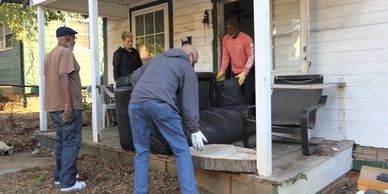
Now Anderson’s vision is coming to fruition. He has started, with a wide range of partners, The Do School, an innovative approach to skills training in the construction industry, crafted for marginalized residents of low-wealth neighborhoods. Participants will take part in a 20-week training program that will prepare them for jobs in the industry and, simultaneously, rehab East Winston houses for sale, revitalizing the area and providing houses for first-time homeowners and others. The many partners include CSEM, Frank L. Blum Construction, Habitat for Humanity of Forsyth County, and Jim Wolfston, the founder and president of CollegeNET, a national group based in Portland, Oregon that supports greater affordability and access to higher education.
Wolfston heard Anderson speak at the 2019 conference at WSSU and invited him out to Portland for further discussions. Wolfston, who sits on the board of nonprofit The Do School, said that Anderson is “defining and actualizing The Do School as a three-way recursion for the benefit of students and the community. The recursion works as follows: Do School facilitates individuals as they rebuild themselves and their skills as they rebuild houses and, thereby, rebuild communities. The effect of rebuilding the community thus reinforces and inspires further ‘calls’ to other individuals to jump into that recursion.”
Anderson lives and breathes this work. He is an entrepreneur who has long worked to break down barriers to economic mobility in East Winston.
“There’s difficulty getting employment,” he said. “Often it is because of the wreckage of their past. I personally know that story.”
The Do School has purchased its first property and will purchase more. It will renovate distressed properties, a training “lab” for construction work, then sell them as affordable housing to support the school. Sustainability is key, Anderson said. Willette Mosby-Reynolds, who has long experience with Habitat, serves as the project manager for The Do School. And most important, board chairman John Lenham, the project manager for Windsor Construction, has provided solid leadership, Anderson said.
Anderson said they started Nov. 2 with four participants with training at Habitat for Humanity, then will move on to their learning lab at Underwood Avenue, a pilot program.
Wolfston said: “Unlike a traditional university curriculum that inculcates general principles and fundamental skills that are then later applied by the student upon graduation, The Do School is premised on a pedagogic strategy of ‘specific to general.’ Do School starts with a specific need and opportunity: Let’s rebuild a house. All participants begin their work on the project by establishing an inventory of tasks and tools. All participants then develop and execute a plan of action.
“As work, mistakes, and rework happen, personal skills, knowledge, satisfaction, and wisdom develop. Participating students and faculty thus leverage and carry forward the personal and collective skills, satisfaction, and confidence from meeting the specific challenge into general principles and wisdom. This is, of course, very much like what we try to do every day as we solve problems in our jobs and in our personal lives.”
Bill Ball, another board member and the CFO of Frank L. Blum Construction, said: “While I know that Frank Blum will participate with The Do School in the form of monetary contributions, I’m convinced that Blum’s impact can be felt much more greatly as we collaborate with our other partners to help support The Do School. I have already approached several of our key subcontractor partners – electrical, HVAC and drywall subcontractors – and in every case these FLB partners have been eager to do whatever they can to help The Do School – volunteering their own time, resources and expertise. I’m confident this type of collaboration is the key to making The Do School work, and in making the difference in our community we hope to make.”
Andersons said, “We’re off to a very good start.” In part, he credits CSEM Associate Director Alvin Atkinson, who supported his work early on, securing him a CSEM award for economic mobility. “Alvin gave me a place at the table,” Anderson said. “He and CSEM Director Craig Richardson allowed space for me to say some things that are outside the mainstream.”
Anderson works to involve more East Winston residents in efforts to break down barriers to economic mobility. “There are people who can really change the trajectory of our communities when they are fully involved,” Anderson said. “It’s part and parcel of our Place, Our Space. We must be the change we want to see. This collaborative model gives everybody a chance to operate in their lane, whatever that might be, ranging from clerical to construction.”
To learn more about The Do School, go to The Do School – Construction Training – Winston-Salem, North Carolina (thedo-school.org)
John Railey, the writer-in-residence for CSEM, can be reached at raileyjb@gmail.com.
Display real testimonials
Display real testimonials
Are your customers raving about you on social media? Share their great stories to help turn potential customers into loyal ones.
Promote current deals
Promote current deals
Display real testimonials
Running a holiday sale or weekly special? Definitely promote it here to get customers excited about getting a sweet deal.
Share the big news
Promote current deals
Share the big news
Have you opened a new location, redesigned your shop, or added a new product or service? Don't keep it to yourself, let folks know.
Display their FAQs
Promote current deals
Share the big news
Customers have questions, you have answers. Display the most frequently asked questions, so everybody benefits.